Skip to content
This post contains affiliate links, which means the website may earn a small commission at no extra cost to you if you make a purchase through them. The HerHealth101 team only recommends products that align with our mission to support women’s health, and is not a reflection of any specific author. Your support helps keep this site growing. Thank you!
A hernia is a common surgical condition that occurs when an organ or fatty tissue squeezes through a weak spot or “hole” in the surrounding muscle or connective tissue, known as fascia. There are some hernias that are associated with development such as umbilical or inguinal hernias and others that can be related to previous surgery such as incisional hernias. The abdominal wall is intended to act as a pressurized container, and a hernia represents a localized breach in that container. While many hernias are initially asymptomatic, they can get larger and eventually cause symptoms such as pain, and other emergencies that include obstruction and strangulation. These cannot be exercised away, and the only known treatment is surgery.

Classification of Hernias
There are many different kind of hernias, and they are categorized primarily by their anatomical location. Some of the most common types include:
- Inguinal Hernia: The most common variety, occurring in the groin. These are more common in men because they often follow the path of the spermatic cord.
- Femoral Hernia: Also located in the groin but slightly lower; these are less common but carry a higher risk of complications, particularly in women.
- Umbilical Hernia: These occur at the navel and are often seen in newborns or in adults due to congenital defects or increased abdominal pressure.
- Incisional Hernia: This occurs at the site of a previous surgical incision where the muscle has weakened over time.
- Less common: Hiatal hernia (common cause of GERD or reflux), diaphragmatic hernia, lumbar hernia.
What Causes a Hernia?
A hernia is generally the result of a combination of pressure and a weakness or opening in the muscle. This weakness can be present at birth due to a congenital defect or develop later in life due to wear and tear.

Anything that causes an increase in intra-abdominal pressure can trigger or worsen a hernia. Common risk factors include:
- Chronic coughing or sneezing (common in smokers or those with COPD).
- Lifting heavy objects without proper stabilization.
- Persistent straining during bowel movements or urination.
- Pregnancy, which significantly increases abdominal wall tension.
- Obesity, which puts constant pressure on the fascia.
Research has also pointed to genetic factors, such as differences in collagen metabolism, which may predispose certain individuals to weaker connective tissue, making them more susceptible to hernias regardless of physical activity levels.
How Do You Know If You Have a Hernia?
The most frequent clinical sign is a visible lump or bulge that may disappear when lying down and reappear with coughing, standing, or straining. Patients often report a dull ache or a sensation of heaviness in the area.
Diagnosing a hernia is typically straightforward:
- Physical Examination: This is the “gold standard.” Your doctor will likely evaluate you in both standing and supine (laying down) positions. You may be asked to “bear down” or perform a Valsalva maneuver (coughing or straining) to “push” the hernia out.
- Ultrasound: Useful for differentiating a hernia from other masses, such as enlarged lymph nodes or lipomas.
- CT Scan: Reserved for complex cases, incisional hernias, or when symptoms suggest a hernia that isn’t visible or felt on physical exam.
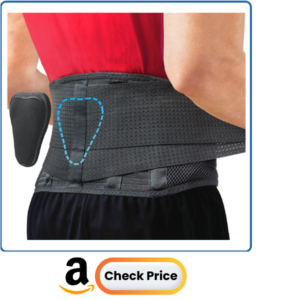
Lumbar Support for Back Pain and Heavy Lifting
Treatment
The only definitive treatment for a hernia is surgical repair. If it is an emergency, such as if the hernia has become trapped or lost blood supply, surgery will be performed right away to prevent tissue necrosis. However, for hernias that are “reducible”, meaning it can be pushed back into the abdominal cavity, the procedure is usually scheduled for a later time after diagnosis pending availability.
The repair itself can be done through either an “open” approach, meaning through a single incision, or using minimally invasive techniques, such as laparoscopic or robotic, depending on the location and severity of the hernia. Also depending on size and location, a small hernia may be fixed by simply stitching up the defect in the abdominal wall, but in most cases, a synthetic mesh will be placed to reinforce the weakened wall and prevent recurrence.
The prognosis for hernia repair is generally excellent. Modern tension-free mesh repairs have reduced the recurrence rate to less than 5% for most primary hernias. Recovery time varies by the individual and location of the hernia, however, after surgery, patients are typically advised to avoid heavy lifting for 4 to 6 weeks to allow for adequate healing.
Woman Specific Considerations:
While inguinal hernias are the most common type of hernia across all genders, women are disproportionally affected by femoral hernias. These occur just below the groin crease, where the femoral artery and vein pass into the thigh. Because the female pelvis is wider, the femoral canal is structurally more prone to this type of weakness. And because the opening is much narrower than the inguinal hernia, they are much more likely to get “stuck”. The biggest concern here is the risk of bowel entrapment and strangulation. In women, these often present not as a visible bulge, but as a deep, vague ache in the upper thigh or groin that can be easily misdiagnosed as a muscle strain or gynecological issue. Warning signs include pain, nausea, vomiting or inability to pass gas or have a bowel movement. Any of these symptoms should be evaluated in the emergency department.
Pregnancy is one of the most significant physiological stressors on the female abdominal wall. The combination of hormonal changes that soften connective tissue and the mechanical pressure of a growing uterus can reveal umbilical hernias during the second and third trimester as the belly button is pushed outward. And while technically not a hernia, there is a condition called diastasis recti, which is the thinning and widening of the connective tissue between the “six pack” muscles of the abdomen. This can create a similar bulge during pregnancy that goes away after delivery; however, the thinned connective tissue can create a lasting weakness that can cause women to develop true hernias in those areas later in life. Also, large diastasis can also cause abdominal wall instability leading to chronic back pain. Physical therapy can significantly improve the appearance and symptoms of these and only rarely do they require surgery.
When it comes to treatment, a common concern for female patients is how a hernia repair (specifically the use of surgical mesh) will hold up or affect future pregnancy. Current research suggests that most modern mesh repairs are safe and effective with pregnancy. However, if a patient is planning to conceive in the very near future, it is always good to discuss that with your doctor so that you can strategize the timing of the repair to ensure the abdominal wall is at its strongest before the “stress test” of a nine-month pregnancy.
It’s true that hernias are often viewed through a male-centric lens due to the high prevalence of inguinal hernias in men. However, hernias are not uncommon in women and by taking into consideration these specific factors, we can be better prepared to have a nuanced understanding of how female anatomy and medical history can affect how hernias may present differently in women so that a proper diagnosis can be made efficiently.
About the Author

Dr. Stephanie Joyce is a board certified and fellowship trained general surgeon, who specializes in trauma and critical care. She is known for her minimally invasive techniques and is a trailblazer in the research and application of robotics for emergency surgery.