Skip to content
This post contains affiliate links, which means the website may earn a small commission at no extra cost to you if you make a purchase through them. The HerHealth101 team only recommends products that align with our mission to support women’s health, and is not a reflection of any specific author. Your support helps keep this site growing. Thank you!
By now, we are all pretty familiar with the menstrual period, but if we are being completely honest, how many of us actually know why it happens, or how it intimately affects our mind, body, and mood? For most women, our collective knowledge does not extend much beyond what we vaguely remember from a high school biology class, or that one time we frantically googled “why I missed my period.” We tend to treat those few days of bleeding as an isolated monthly chore, rather than the culmination of a massive, month-long biochemical dance that is constantly running in the background. Consider this your ultimate masterclass, a clear guide on exactly what happens, why it happens, and how these shifting hormones ripple out to affect your brain chemistry and daily mood to your appetite, sleep, and absolute everything else.
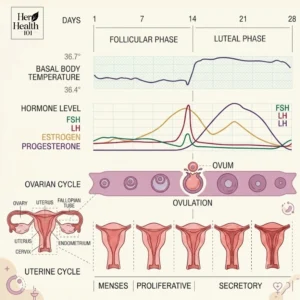
Everything begins on day one, which is the very first day of your full menstrual bleed. This is the start of what medicine calls the follicular phase, which includes your period. At this moment, your hormone levels, specifically estrogen and progesterone, are at their absolute lowest point. It is completely normal to feel a bit turned inward during these first few days. Your body is doing heavy physical work to clear out the old uterine lining because pregnancy did not occur in the previous cycle.

But even while you are bleeding, your brain is already planning ahead. A tiny region called the hypothalamus releases a hormone called gonadotropin-releasing hormone (GnRH) to the pituitary gland. Think of the hypothalamus as the body’s control center, constantly monitoring internal conditions that need to be regulated, like temperature, hunger and hormone levels. And you can think of the pituitary as the officer in charge of relaying messages to the organs involved to make the appropriate adjustments as needed. So when the pituitary gland receives GnRH, it responds by releasing another hormone called the follicle-stimulating hormone (FSH) to the ovaries, signalling them to stimulate a handful of fluid-filled sacs called follicles to start growing. Each of these little sacs houses an immature egg. That’s why we call the first half of your cycle the follicular phase, because it is when the follicles are stimulated to start maturing. As they do so, they begin secreting estrogen into your bloodstream.

By the time your period ends, usually around day five or six, estrogen really takes center stage. It tells the lining of your uterus to grow thick, plush, and rich with blood vessels to create a welcoming environment for a potential pregnancy. You may also hear this part of the follicular phase also referred to as the proliferative phase since your uterine lining is literally proliferating. Because estrogen also boosts serotonin and dopamine in the brain, you will likely notice a significant shift in your mood and energy during this week. You might feel more social, more focused, and ready to take on intense workouts.

Saalt Menstrual Disc – Reusable Silicone Period Disc – 12 Hours Leak-Free Protection
Eventually, one dominant follicle wins the race and grows larger than all the others. When estrogen levels peak, halfway through your cycle, it is accompanied by a massive surge of another hormone called luteinizing hormone, which triggers ovulation, the main event of your cycle! What happens during ovulation is that dominant follicle ruptures and releases a mature egg into the fallopian tube. The egg only survives for about twenty-four hours, meaning this is your brief window for conception.

In most textbooks, they say ovulation happens right around day 14, but in reality, very few women have a perfectly predictable 28 day cycle every single month. That’s why it is actually more accurate to say that ovulation occurs 14 days before your next period starts.
And because ovulation is triggered by luteinizing hormone, we now enter what’s known as the luteal phase (or secretory phase). The empty follicle that just released the egg transforms into a temporary gland called the corpus luteum. This little powerhouse begins pumping out progesterone. If estrogen is the energetic builder, progesterone is the calm, soothing keeper of the peace. It stabilizes the uterine lining, relaxes your nervous system, and helps you sleep deeply. During the first half of this phase, you might feel grounded and deeply relaxed. However, if the egg is not fertilized, the corpus luteum eventually runs out of steam and breaks down. Progesterone and estrogen levels both take a sharp plunge. This sudden drop is what triggers the physical and emotional shifts we often call PMS. Your body realizes it does not need to maintain that thick uterine lining, the blood vessels constrict, and the excess tissue is shed out, resetting your menstrual cycle back to day one.
Paying attention to these shifts allows you to understand why you might feel like running a marathon one week and curling up with a book the next. Your body is not meant to operate at the exact same baseline every single day, and forcing yourself into a rigid routine ignores the beautiful rhythm that keeps you healthy. If your cycle is wildly irregular, or if your symptoms feel completely overwhelming, it is your body waving a flag to ask for support. Lean into these natural transitions, listen to what your hormones are telling you, and remember that taking care of your cyclical health is one of the most powerful forms of self care a woman can do.

About the author:

Dr. Katherine Choi is a board certified obstetrician and gynecologist. She is known for her minimally invasive surgical techniques and specializes in uterine disorders, such as endometriosis and fibroids.